

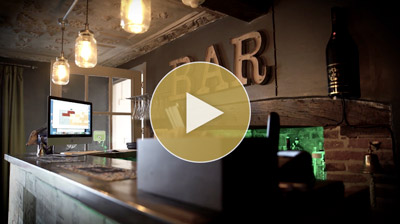
Most of Sutherland House is reputed to have been constructed in about 1455, with Georgian and Victorian extensions. The building is Grade 2* Listed, which shows that as well as being of architectural significance it is also of historical importance.
In addition to the open fireplaces, exposed beams, wood panelling and lath and plaster walls that you would expect to find in a house of this age, there are two magnificent decorative plaster ceilings – an East Anglian craft known as pargetting – that date from the 1660’s. These ceilings were created to celebrate the fact that Sutherland House was the residence of the Duke of York (later James II) and the Earl of Sandwich during the time that the house was temporary headquarters of the Admiralty during the Anglo Dutch War (1665 – 1674). Both the Stuart fleur de lys and the rose of the Earls of Sandwich can be seen in the design of the ceilings.
During this war there were several major sea battles fought off the East Anglian coast, and the two Admirals stayed at Sutherland House whenever they were able. Before this time the house was the home of a rich Elizabethan merchant, Thomas Camel, and was known as Camel House. What is now Victoria Street was then called Camel Lane.
After that the house was the residence of the Mayor of Southwold, Dr John Sutherland, who gave it the name by which we now know it. At the turn of the 20th century the house became a school, and was then converted to its current use as a small hotel and restaurant. The interior design now contrasts with the antiquity of the building to bring a contemporary twist to a beautiful old building, with Zoffany and Designer Guild fabrics and design classics such as Le Corbuisier chaise longues throughout the building.
In addition to the open fireplaces, exposed beams, wood panelling and lath and plaster walls that you would expect to find in a house of this age, there are two magnificent decorative plaster ceilings – an East Anglian craft known as pargetting – that date from the 1660’s. These ceilings were created to celebrate the fact that Sutherland House was the residence of the Duke of York (later James II) and the Earl of Sandwich during the time that the house was temporary headquarters of the Admiralty during the Anglo Dutch War (1665 – 1674). Both the Stuart fleur de lys and the rose of the Earls of Sandwich can be seen in the design of the ceilings.
During this war there were several major sea battles fought off the East Anglian coast, and the two Admirals stayed at Sutherland House whenever they were able. Before this time the house was the home of a rich Elizabethan merchant, Thomas Camel, and was known as Camel House. What is now Victoria Street was then called Camel Lane.
After that the house was the residence of the Mayor of Southwold, Dr John Sutherland, who gave it the name by which we now know it. At the turn of the 20th century the house became a school, and was then converted to its current use as a small hotel and restaurant. The interior design now contrasts with the antiquity of the building to bring a contemporary twist to a beautiful old building, with Zoffany and Designer Guild fabrics and design classics such as Le Corbuisier chaise longues throughout the building.